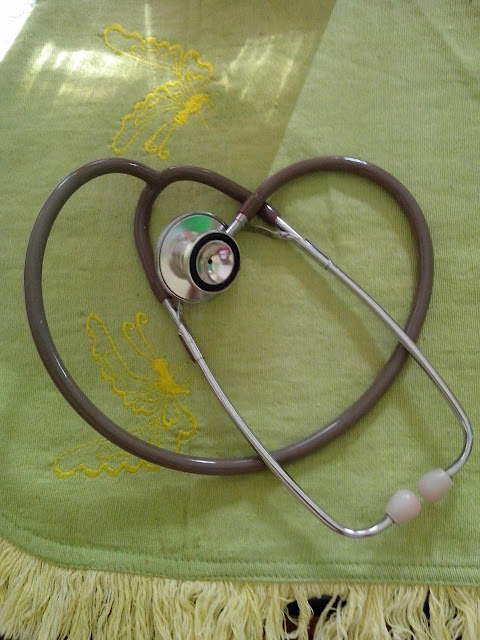
• How Stethoscope Works....

    A stethoscope is a medical device for listening to sounds inside the body. The initial stethoscope was invented in the early 19th century by French physician Ren� Laennec, but was actually trying to achieve a rather different end: doctor-patient distance....

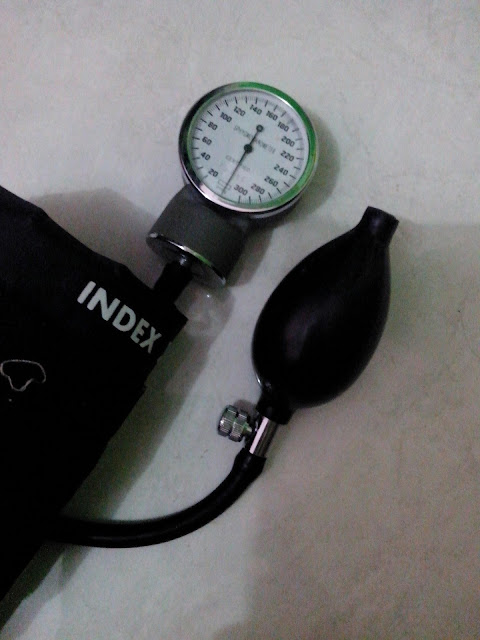
  • Care Plan For Decreased Cardiac Output...

    Nursing diagnosis for decreased cardiac output may be related to altered myocardial contractility, inotropic changes; alterations in rate, rhythm, electrical conduction; or structural changes, such as valvular defects and ventricular aneurysm. ...

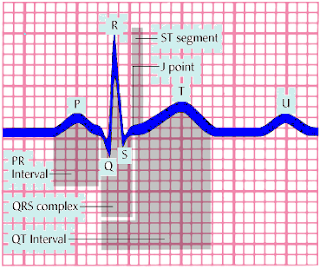
  • ECG Waveforms And Components

    The electrocardiogram (ECG) is a graphic recording ofelectric potentials generated by the heart.The signals are detected by means of metal electrodes attached to the extremities and chest wall and are then amplified and recorded by the electrocardiograph. ECG leads actually display the instantaneous differences in potential between these electrodes. ...

Showing posts with label assessment. Show all posts

Friday, July 10, 2015

Assessment of Cranial Nerves in The Child

Assessment of cranial nerves in the child. Obtained from Hadley (1994). S Sensory, M motor, EOM extraocular movement.
Cranial
Test for function
I Olfactory (S)
 
Olfactory nerve, mucous membrane of nasal
passages and turbinates
 With eyes closed child is asked to identify familiar odors such as peanut
 butter, orange, and peppermint. Test each nostril separately
II Optic (S)
 
Optic nerve, retinal rods and cones
 Check visual acuity, peripheral vision, color vision, perception of light in
 infants, fundoscopic examination for normal optic disk
III Oculomotor (M)
 
Muscles of the eyes (superior rectus, inferior
rectus, medial rectus, inferior oblique)
 Have child follow an object or light with the eyes (EOM) while head
 remains stationary. Check symmetry of corneal light reflex. Check for
 nystagamus (direction elicited, vertical, horizontal, rotary).
 Check cover-uncover test.
Muscles of iris and ciliary body
 Reaction of pupils so light, both direct and consensual, accommodation
Levator palpebral muscle
 Check for symmetric movement of upper eyelids. Note ptosis
IV Trochlear (M)
 
Muscles of eye (superior oblique)
 Check the range of motion of the eyes downward (EOM). Check for
 nystagmus
V Trigeminal (M, S)
 
Muscles of mastication (M)
 Palpate the child’s jaws, jaw muscles, and temporal muscles for strength and
 symmetry. Ask child to move lower jaw from side to side against
 resistance of the examiner’s hand
Sensory innervation of face (S)
 Test child for sensation using a wisp of cotton, warm and cold water in test
 tubes, and a sharp object on the forehead, cheeks, and jaw. Check corneal reflex
 by touching a wisp of cotton to each cornea. The normal response is blink
VI Abducens (M)
 
Muscles of eye (lateral rectus)
 Have child look to each side (EOM)
VII Facial (M, S)
 
Muscles for facial expression
 Have child make faces: look at the ceiling, frown, wrinkle forehead, blow out
 cheeks, smile. Check for strength, asymmetry, paralysis
Sense of taste on anterior two-thirds of tongue.
Sensation of external ear canal, lachrymal,
submaxillary, and sublingual glands
 Have a child identify salt, sugar, bitter (flavoring extract), and sour
 substances by placing substance on anterior sides of tongue. Keep tongue out
 until substance is identified. Rinse mouth between substances
VIII Acoustic (S)
 
Equilibrium (vestibular nerve)
 Note equilibrium or presence of vertigo (Romberg sign)
Auditory acuity (cochlear nerve)
 Test hearing. Use a tuning fork for the Weber and Rinne tests.
 Test by whispering and use of a watch
IX Glossopharyngeal (M, S)
 
Pharynx, tongue (M)
 Check elevation of palate with “ah” or crying. Check for movement and
 symmetry. Stimulate posterior pharynx for gag reflex
Sense of taste posterior third of the tongue
 Test sense of taste on posterior portion of tongue

X Vagus (M, S)
 
Mucous membrane of pharynx, larynx, bronchi,
lungs, heart, esophagus, stomach, and kidneys

Posterior surface of external ear and external
auditory meatus
 Note same as for glossopharyngeal. Note any hoarseness or stridor. Check
 uvula for midline position and movement with phonation. Stimulate uvula
 on each side with tongue depressor – should rise and deviate to stimulated
 side. Check gag reflex. Observe ability to swallow
XI Accessory (M)
 
Sternocleidomastoid and upper trapezius
muscles
 Have child shrug shoulders against mild resistance. Have child turn head
 to one side against resistance of examiner’s hand. Repeat on the other side.
 Inspect and palpate muscle strength, symmetry for both maneuvers
XII Hypoglossal (M)
 
Muscle of tongue
 Have child move the tongue in all directions, then stick out tongue as far as
 possible: check for tremors or deviations. Test strength by having child push
 tongue against inside cheek against resistance on outer cheek. Note strength,
 movement, symmetry
Read More

Saturday, May 31, 2014

LAWTON SCALE FOR INSTRUMENTAL ACTIVITIES OF DAILY LIVING

The Lawton scale evaluates more sophisticated functions than the Katz index. Patients or caregivers can complete the form in a few minutes. The first answer in each case—except for 8a—indicates independence, the second indicates capability with assistance, and the third indicates dependence. In this version, the maximum score is 29, although scores have meaning only for an individual patient, as when declining scores over time reveal deterioration. Questions 4 to 7 tend to be gender-specific; modify them as necessary.

1. Can you use the telephone?  
without help â‘¢
with some help 2
completely unable 1

2. Can you get to places beyond walking distance?  
without help â‘¢
with some help 2
not without special arrangements 1

3. Can you go shopping for groceries?  
without help â‘¢
with some help 2
completely unable 1

4. Can you prepare your own meals?  
without help â‘¢
with some help 2
completely unable 1

5. Can you do your own housework?  
without help 3
with some help â‘¡
completely unable 1

6. Can you do your own handyman work?  
without help 3
with some help â‘¡
completely unable 1

7. Can you do your own laundry?  
without help â‘¢
with some help 2
completely unable 1

8a. Do you take medicines or use any medications?  
Yes (If yes, answer Question 8b.)‘ ①
No (If no, answer Question 8c.) 2

8b. Do you take your own medicine?  
without help (in the right doses at the right times) â‘¢
with some help (if someone prepares it for you and/or reminds you to take it) 2
completely unable 1

8c. If you had to take medicine, could you do it?  
without help (in the right doses at the right time) â‘¢
with some help (if someone prepared it for you and reminded you to take it) 2
completely unable 1

9. Can you manage your own money?  
without help â‘¢
with some help 2
completely unable 1

Adapted with permission
Read More

Friday, September 6, 2013

Essential Skills For Assessment In Nursing Process Steps

Assessment requires the use of the skills needed for interviewing, conducting a physical examination, and observing patients. As with the nursing process itself, these skills are not used one at a time. While you are interviewing the patient, you are also observing and determining physical areas that require a detailed physical assessment. While completing a physical assessment, you are asking questions (interviewing) and observing the patient’s physical appearance as well as the patient’s response to the physical examination.

Interviewing generally starts with gathering data for the nursing history. In this interview, you ask for general demographic information such as name, address, date of last hospitalization, age, allergies, current medications, and the reason the patient was admitted. Depending on the agency’s admission form, you may then progress to other specific questions or a physical assessment.

The physical assessment calls for four skills: inspection, palpation, percussion, and auscultation. Inspection means careful and systematic observation throughout the physical examination, such as observation for and recording of any skin lesions. Palpation is assessment by feeling and touching the patient. Assessing the differences in temperature between a patient’s upper and lower arm would be an example of palpation. Another common example of palpation is breast self-examination. Percussion involves touching, tapping, and listening. Percussion allows determination of the size, density, locations, and boundaries of the organs. Percussion is usually performed by placing the index or middle finger of one hand firmly on the skin and striking with the middle finger of the other hand. The resultant sound is dull if the body is solid under the fingers (such as at the location of the liver) and hollow if there is a body cavity under the finger (such as at the location of the abdominal cavity). Auscultation involves listening with a stethoscope and is used to help assess respiratory, circulatory, and gastrointestinal status.

The physical assessment may be performed using a head-to-toe approach, a body system approach, or a functional health pattern approach. In the head-to-toe approach, you begin with the patient’s general appearance and vital signs. You then progress, as the name indicates, from the head to the extremities.

The body system approach to physical assessment focuses on the major body systems. As the nurse is conducting the nursing history interview, she or he will get a firm idea of which body systems need detailed examination. An example is a cardiovascular examination, where the apical and radial pulses, blood pressure (BP), point of maximum intensity (PMI), heart sounds, and peripheral pulses are examined.

The functional health pattern approach is based on Gordon’s Functional Health Patterns typology and allows the collection of all types of data according to each pattern. This is the approach used by this book and leads to three levels of assessment. First is the overall admission assessment, where each pattern is assessed through the collection of objective and subjective data. This assessment indicates patterns that need further attention, which requires implementation of the second level of pattern assessment. The second level of pattern assessment indicates which nursing diagnoses within the pattern might be pertinent to this patient, which leads to the third level of assessment, the defining characteristics for each individual nursing diagnosis. Having a three-tiered assessment might seem complicated, but each assessment is so closely related that completion of the assessment is easy. A primary advantage in using this type of assessment is the validation it gives to the nurse that the resulting nursing diagnosis is the most correct diagnosis. Another benefit to using this type of assessment is that grouping of data is already accomplished and does not have to be a separate step.

 
Read More
Powered by Blogger.

Search This Blog